
Argenteuil
c. 1872
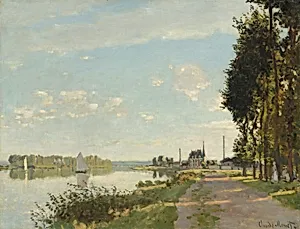
Medium
oil on canvas
Dimensions
overall: 50.4 x 65.2 cm (19 13/16 x 25 11/16 in.) framed: 70.8 x 85.7 x 8.3 cm (27 7/8 x 33 3/4 x 3 1/4 in.)
Classification
Painting
Department
CF
Museum
National Gallery of Art, Washington, D.C.
Credit
Ailsa Mellon Bruce Collection
Accession Number
1970.17.42
Rights
Public Domain
Art Historical Context
Claude Monet's *Argenteuil* (c. 1872), an oil on canvas measuring 50.4 x 65.2 cm, captures the artist's fascination with the suburban landscapes along the Seine River. After the Franco-Prussian War disrupted life in Paris, Monet settled in Argenteuil from 1871 to 1878, finding inspiration in its serene waterways, boating scenes, and shifting light. This painting exemplifies his early Impressionist experiments, painted en plein air to seize the transient beauty of everyday vistas. Monet's loose, dappled brushstrokes and vibrant color palette dissolve forms into atmospheric effects, prioritizing sensation over precise detail—a revolutionary break from academic traditions. As a cornerstone of Impressionism, the work highlights oil on canvas's versatility for capturing luminosity and movement, influencing generations of artists to embrace modernity's fleeting moments. Housed in the National Gallery of Art's Ailsa Mellon Bruce Collection, *Argenteuil* invites visitors to linger, appreciating how its intimate scale draws the eye into a world of shimmering reflections and gentle breezes. A testament to Monet's enduring vision, it reminds us of art's power to distill joy from the ordinary.
About the Artist
Claude Monet · 1840–1926
Claude Monet, born Oscar-Claude Monet on November 14, 1840, in Paris and raised in Le Havre, Normandy, began his artistic journey as a successful teenage caricaturist. His formal training started at the Le Havre secondary school of the arts in 1851, where he received his first drawing lessons from Jacques-François Ochard. Around 1858, he met Eugène Boudin, who became his pivotal mentor, introducin...