
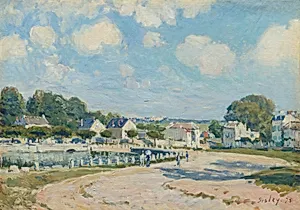
Watering Place at Marly
1875
Medium
Oil on canvas
Dimensions
39.5 × 56.2 cm (15 7/16 × 22 1/8 in.); Framed: 63.9 × 80.7 × 9.6 cm (25 1/8 × 31 3/4 × 3 3/4 in.)
Classification
oil on canvas
Department
Painting and Sculpture of Europe
Museum
Art Institute of Chicago
Accession Number
37741
Rights
Public Domain
About this artwork
In 1875 Alfred Sisley moved to the village of Marly-le-Roi, where in the 1600s King Louis XIV had built an elegant country retreat. The artist’s home on the rue de l’Abreuvoir flanked the pool, or “watering place,” featured on the left of this canvas. The pool was all that remained of the water gardens that had been part of the king’s park. Sisley remained faithful to landscape subjects throughout his career, spending most of his life painting in the villages along the Seine River, in the regio...
Art Historical Context
Alfred Sisley, a leading figure in the Impressionist movement, painted "Watering Place at Marly" in 1875 during a pivotal period for modern art. As a British-born artist who spent most of his career in France, Sisley focused almost exclusively on landscapes, using loose brushwork and vibrant color to capture the changing effects of light and weather. This small-scale oil on canvas reflects the Impressionists' preference for working outdoors to record fleeting moments in nature. The scene portrays a tranquil spot near Paris, where Sisley often painted the countryside around Marly-le-Roi. Created just a year after the first Impressionist exhibition, the work embodies the movement’s break from academic traditions, emphasizing atmosphere over precise detail. Its modest size invites close viewing, highlighting Sisley’s subtle handling of tones and reflections. Today housed in the Art Institute of Chicago’s collection of European paintings, this piece offers visitors a window into late-19th-century France’s rural charm and the innovative spirit of Impressionism.
About the Artist
Alfred Sisley · 1839–1899
Alfred Sisley (1839–1899) was a British-born French Impressionist landscape painter who remained the most consistently devoted to pure Impressionist principles throughout his career. Born in Paris to prosperous English parents, he studied at the atelier of Charles Gleyre alongside Claude Monet, Pierre-Auguste Renoir, and Frédéric Bazille, forming friendships that placed him at the heart of the eme...