
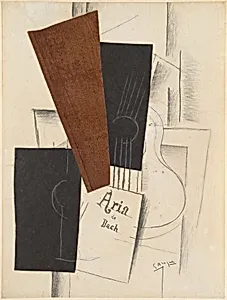
Aria de Bach
1913
Medium
collage of black paper and imitation wood-grain paper with charcoal and white chalk on white paper
Dimensions
Overall (approximate): 62.1 x 46.9 cm (24 7/16 x 18 7/16 in.) support: 45.2 x 50.4 cm (17 13/16 x 19 13/16 in.)
Classification
Drawing
Department
CG-W
Museum
National Gallery of Art, Washington, D.C.
Credit
Collection of Mr. and Mrs. Paul Mellon
Accession Number
1982.55.2
Rights
Public Domain
Art Historical Context
Georges Braque’s *Aria de Bach* (1913) exemplifies the innovative spirit of Cubism during its Synthetic phase. Working alongside Pablo Picasso, Braque helped pioneer collage techniques that challenged traditional notions of representation. The title evokes Johann Sebastian Bach’s music, a frequent inspiration for Cubist artists who sought to capture rhythm, harmony, and multiple viewpoints within a single composition. Created through a collage of black paper and imitation wood-grain paper, accented with charcoal and white chalk, the work demonstrates Braque’s fascination with texture and illusion. By incorporating everyday materials, he blurred the boundary between fine art and ordinary objects, inviting viewers to reconsider how reality is constructed on the picture plane. This papier collé method, developed around 1912, marked a pivotal shift in modern art. Held in the National Gallery of Art’s collection thanks to Mr. and Mrs. Paul Mellon, *Aria de Bach* remains a compelling example of how Braque transformed humble papers into a sophisticated meditation on music, form, and perception.
About the Artist
Georges Braque · 1882–1963
Georges Braque (1882–1963) was a French painter, collagist, and sculptor who, together with Pablo Picasso, invented Cubism — one of the most revolutionary developments in the history of Western art. Born in Argenteuil and raised in Le Havre, he initially trained as a house painter and decorator before studying fine art at the Académie Humbert and the École des Beaux-Arts in Paris. Braque's early ...