
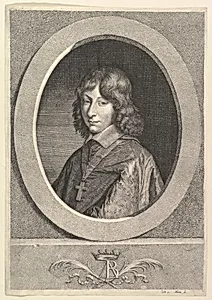
Armand de Bourbon-Conti, prince du sang
Medium
Etching, second state
Dimensions
image: 14 3/8 x 10 1/16 in. (36.5 x 25.5 cm)
Classification
Prints
Department
Drawings and Prints
Museum
Metropolitan Museum of Art, New York, NY
Credit
Harris Brisbane Dick Fund, 1942
Accession Number
42.3
Rights
Public Domain
Tags
Art Historical Context
This elegant etching portrays Armand de Bourbon-Conti, a *prince du sang*—a prince of the royal bloodline in 17th-century France. Created by the skilled engravers Jean Morin, a French master of reproductive prints, and Justus Egmont, a Flemish known for his refined portraits, the work captures the nobleman's dignified presence. Measuring 14⅜ × 10¹⁄₁₆ inches (36.5 × 25.5 cm), it belongs to the second state, indicating refinements made after the initial printing, a common practice to enhance detail and clarity. Etching, the medium here, was a revolutionary intaglio technique popular in the Baroque era, allowing artists to achieve delicate lines and tonal depth by biting acid into a metal plate. This portrait exemplifies its power for disseminating images of aristocracy across Europe, making elite likenesses accessible beyond oil paintings. Housed in The Metropolitan Museum of Art's Drawings and Prints department, acquired through the Harris Brisbane Dick Fund in 1942, it reflects the era's fascination with noble identity amid France's turbulent politics, including the Fronde rebellions where Conti played a key role. Though the exact date is unknown, the print's style evokes mid-17th-century elegance, offering visitors a window into the grandeur of Bourbon nobility and the artistry of collaborative printmaking.
About the Artist
Jean Morin|Justus van Egmont · 1605–1650
Jean Morin (c. 1605–1650) was one of the most accomplished French engravers of the seventeenth century, a master of the portrait print whose work stands among the finest examples of French graphic art in its era. Little is known about his early life or training, though his technique suggests exposure to both French and Flemish engraving traditions, the latter being the dominant force in European p...