
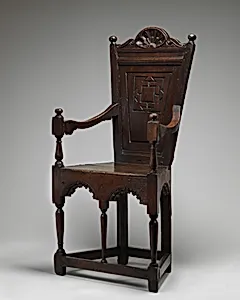
Armchair
Unknown Artist
ca. 1600–1625
Medium
Oak
Dimensions
Overall (confirmed): 49 3/8 × 24 3/4 × 19 in. (125.4 × 62.9 × 48.3 cm)
Classification
Woodwork-Furniture
Culture
British, probably West Country
Department
European Sculpture and Decorative Arts
Museum
Metropolitan Museum of Art, New York, NY
Credit
Bequest of Irwin Untermyer, 1973
Accession Number
1974.28.73
Rights
Public Domain
Art Historical Context
Step into the world of early 17th-century British domestic life with this striking oak armchair, crafted around 1600–1625 in the West Country of England. Measuring an impressive 49 3/8 × 24 3/4 × 19 inches, this substantial piece of furniture reflects the robust woodworking traditions of the period, when oak—prized for its durability and rich grain—was the material of choice for high-status homes. Likely made by a skilled local craftsman whose name has been lost to time, it exemplifies the Jacobean era's blend of medieval solidity and emerging Renaissance influences. In the West Country, regions like Devon and Somerset were renowned for their furniture makers, who produced armchairs like this one as symbols of comfort and social standing. These chairs often featured carved details and sturdy construction suited to the damp English climate, serving as thrones for family patriarchs by the hearth. Its presence in the Metropolitan Museum of Art's European Sculpture and Decorative Arts collection, thanks to the 1973 bequest of Irwin Untermyer, highlights its enduring value as a snapshot of everyday luxury. Today, this armchair invites us to ponder the anonymous artisans who shaped Britain's decorative arts heritage, reminding visitors of how furniture was both functional art and a marker of cultural identity in Tudor-Stuart England.