
Armchair
1865–70
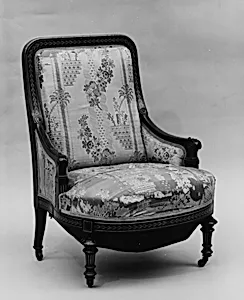
Medium
Rosewood, marquetry, gilt
Dimensions
34 5/8 x 25 x 26 3/4 in. (87.9 x 63.5 x 67.9 cm)
Classification
Armchair
Culture
American
Department
The American Wing
Museum
Metropolitan Museum of Art, New York, NY
Credit
Gift of Paul Martini, 1972
Accession Number
1972.76
Rights
Public Domain
Art Historical Context
Step into the opulent world of Gilded Age America with this exquisite *Armchair* crafted by the Herter Brothers around 1865–70. Renowned New York cabinetmakers of German origin, the Herter firm—led by brothers Gustave and Christian—specialized in luxurious furniture for America's elite, including tycoons like the Vanderbilts. This piece, now in the Metropolitan Museum of Art's American Wing, exemplifies their mastery during the post-Civil War boom, when industrial wealth fueled a demand for grand interiors blending European grandeur with emerging American tastes. Fashioned from rich rosewood with intricate marquetry—inlaid veneers forming delicate floral and geometric patterns—and accents of gilt, the armchair measures a compact yet stately 34 5/8 x 25 x 26 3/4 inches. Marquetry, a technique rooted in 17th-century French ébénisterie, highlights the Herters' technical virtuosity and nod to the Renaissance Revival style, while subtle gilding adds a touch of Aesthetic Movement elegance, prioritizing beauty and craftsmanship over mere utility. A gift to the Met in 1972, this chair offers a tangible glimpse into 19th-century domestic splendor, where furniture was both functional art and a status symbol. Imagine it in a Manhattan mansion, inviting refined repose amid velvet drapes and gaslight— a testament to America's rising cultural confidence.