
Armchair
1830–35
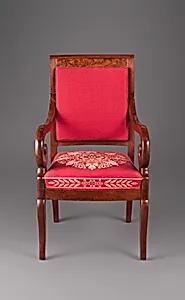
Medium
Mahogany, cherry, ash
Dimensions
38 x 21 1/4 x 25 1/2 in. (96.5 x 54 x 64.8 cm)
Classification
Armchair
Culture
American
Department
The American Wing
Museum
Metropolitan Museum of Art, New York, NY
Credit
Gift of Mrs. Alfred Joltin, in memory of Ida Louise Opdycke, 1971
Accession Number
1971.128.1
Rights
Public Domain
Art Historical Context
Step into the refined world of 19th-century American craftsmanship with this elegant armchair by Duncan Phyfe crafted between 1830 and 1835. Phyfe, a Scottish-born master cabinetmaker who rose to prominence in New York City, epitomized the neoclassical style adapted for American tastes. His designs blended clean lines, subtle carving, and classical motifs inspired by ancient Greece and Rome, making fine furniture accessible to the emerging middle and upper classes. Made from luxurious mahogany—a dense, richly grained tropical wood imported from the West Indies—accented with cherry and ash for structural elements, this piece showcases exceptional joinery and hand-finishing techniques. At 38 x 21¼ x 25½ inches, its proportions offer both comfort and grandeur, ideal for a formal parlor. Phyfe's workshop produced thousands of such pieces, but attributed works like this one highlight his signature reeded legs and upholstered seats, reflecting the Federal period's shift toward opulence amid America's growing prosperity. Displayed in The Metropolitan Museum of Art's American Wing, this armchair, a 1971 gift in memory of Ida Louise Opdycke, embodies cultural pride in domestic refinement. It invites us to imagine genteel conversations in a bustling young republic, where furniture was both functional art and a statement of status.
About the Artist
Duncan Phyfe · 1770–1854
Duncan Phyfe (1770–1854) was a Scottish-born American cabinetmaker who became the most celebrated furniture maker in the history of American decorative arts. Born Duncan Fife near Loch Fannich in the Scottish Highlands, he emigrated with his family to Albany, New York, around 1783–84, where he apprenticed to a cabinetmaker. By 1792 he had established his own workshop on Partition Street (later Ful...