
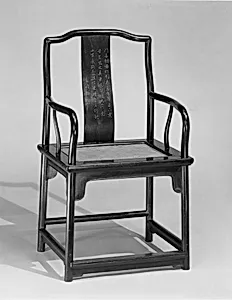
Armchair
Unknown Artist
17th century
Medium
Purple sandalwood (zitan)
Dimensions
H. 40 1/8 In. (101.9 cm); W. 22 3/8 in. (56.8 cm); D. 18 1/8 in. (45.7 cm)
Classification
Furniture
Culture & Period
China · late Ming (1368–1644) or early Qing (1644–1911) dynasty
Department
Asian Art
Museum
Metropolitan Museum of Art, New York, NY
Credit
Purchase, The Vincent Astor Foundation Gift, 1976
Accession Number
1976.193.3a, b
Rights
Public Domain
Art Historical Context
This elegant armchair, crafted from rare purple sandalwood (z) in 17th-century China, exemplifies the exquisite furniture of the late Ming (1368–1644) or early Qing (164–1911) dynasty Measuring 40 1/8 inches high, with a seat width of 22 3/8 inches and depth of 181/8 inches, its form is both functional and refined, designed for seated contemplation or receiving guests. Zitan, a dense hardwood with a rich purple hue and fine grain, was highly prized for imperial and scholarly use due to its scarcity and resistance to insects, making pieces like this symbols of wealth and refinement. During this transitional era, Chinese furniture makers achieved mastery in joinery techniques, assembling frames without nails or glue for durability and purity of line. The armchair reflects Ming ideals of simplicity and proportion, possibly blending into early Qing opulence, underscoring a cultural shift from scholarly minimalism to courtly grandeur. Such chairs elevated everyday seating into art, embodying Confucian values of hierarchy and harmony. Acquired through the Vincent Astor Foundation Gift in 1976, this treasure from the Metropolitan Museum of Art's Asian Art collection invites visitors to appreciate the understated luxury of imperial China. (198 words)