
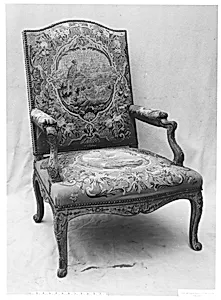
Armchair (fauteuil)
first quarter 18th century
Medium
Carved walnut, Aubusson tapestry cover
Dimensions
43 × 29 1/4 × 27 in. (109.2 × 74.3 × 68.6 cm)
Classification
Woodwork-Furniture
Culture
French
Department
European Sculpture and Decorative Arts
Museum
Metropolitan Museum of Art, New York, NY
Credit
Gift of J. Pierpont Morgan, 1906
Accession Number
07.225.61
Rights
Public Domain
Tags
Art Historical Context
Step into the opulent world of early 18th-century French interiors with this exquisite *fauteuil*, or armchair, crafted in the first quarter of the 170s. Made of finely carved walnut, its frame showcases the intricate woodworking techniques of the Régence—a transitional era between the grandeur of Louis XIV and lighter elegance of Louis XV. The chair's open-arm design and subtle curves reflect the shift toward comfort and refinement in aristocratic furnishings, standing at a stately 43 inches tall. What truly elevates this piece is its Aubusson tapestry cover, a hallmark of French luxury textiles from the renowned workshops in Aubusson, France. Woven on low-warp looms, these durable, flat tapestries feature vibrant pastoral motifs of animals, birds, and flowers, evoking the natural abundance celebrated in Rococo precursors. Such upholstery was reserved for the elite, blending sculpture-like carving with sumptuous weaving to create multifunctional art for salons and boudoirs. Generously gifted to The Metropolitan Museum of Art in 1906 by financier J. Pierpont Morgan, this fauteuil offers a tangible glimpse into France's Golden Age of decorative arts, where furniture was both seat and statement of status.