
Armchair
1939
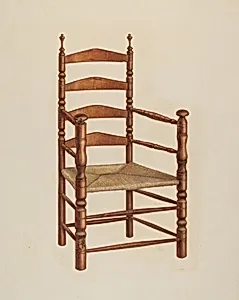
Medium
watercolor, colored pencil, and graphite on paperbaord
Dimensions
overall: 40.6 x 30.6 cm (16 x 12 1/16 in.) Original IAD Object: 43"high; 26"deep; 16 1/2"wide
Classification
Index of American Design
Department
CG-W
Museum
National Gallery of Art, Washington, D.C.
Credit
Index of American Design
Accession Number
1943.8.4541
Rights
Public Domain
Art Historical Context
Isadore Goldberg's *Armchair* (1939) is a meticulous rendering created as part of the Index of Design, a landmark WPA Federal Art Project from the Great Depression era. watercolor, colored pencil, and graphite on paperboard (406 x 30.6 cm) captures the form and details of an original armchair measuring 43 inches high, 26 inches deep, 16½ inches wide. Goldberg's precise technique highlights the chair's craftsmanship, blending artistic skill with documentary accuracy to preserve everyday American design. The Index of American Design, active from 1935 to 1942, commissioned over 15,000 such renderings by artists across the U.S. to celebrate and safeguard folk art, furniture, and decorative objects reflective of regional traditions. Housed in the National Gallery of Art's collection (Department: CG-W), this work exemplifies the project's goal of democratizing art history, making cultural heritage accessible amid economic hardship. Goldberg's vibrant yet faithful depiction invites viewers to appreciate the armchair's functional elegance—likely a product of American woodworking prowess—while underscoring the era's emphasis on national identity through design. A testament to Depression-era ingenuity, it bridges art, history, and everyday life.
About the Artist
Isadore Goldberg · 1904–1995
Isadore Goldberg (b. 1904), an American artist, gained recognition through his contributions to the Index of American Design, a New Deal-era initiative under the Works Progress Administration's Federal Art Project. Active primarily in the late 1930s and early 1940s, Goldberg produced meticulous renderings of everyday American objects, capturing the essence of folk craftsmanship during a time when ...