
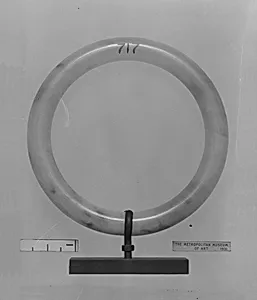
Armlet
Unknown Artist
1796–1875
Medium
Jadeite
Dimensions
H. 3 9/16 in. (9 cm); W. 3/8 in. (1 cm)
Classification
Jade
Culture & Period
China · Qing dynasty (1644–1911)
Department
Asian Art
Museum
Metropolitan Museum of Art, New York, NY
Credit
Gift of Heber R. Bishop, 1902
Accession Number
02.18.717
Rights
Public Domain
Art Historical Context
This exquisite jadeite armlet, in China during the Qing dynasty (4–1911) 1796 and 1875, exemplifies the era's mastery of jade carving. Measuring a slender 3 9/16 inches high and just 3/8 inch wide, it was likely worn as an elegant bracelet or upper-arm ornament, highlighting the wearer's refined taste and status. Gifted to the Metropolitan Museum of Art 1902 by Heber R. Bishop, it in the Asian Art department, a testament to early Western fascination with Chinese imperial artistry. Jadeite, a vivid and durable variety of jade rarer than nephrite, held profound cultural symbolism in China, evoking purity, immortality, and moral virtue—qualities emperors claimed for themselves. Qing artisans perfected techniques like incising, drilling, and polishing to unlock the stone's translucent glow, often transforming raw boulders into fluid, life-like forms. Though the artist's identity is lost to time, this piece reflects the dynasty's opulent jade workshops, where such jewelry adorned the elite during a period of artistic peak before political upheavals. Visitors, picture this armlet catching the light in a scholar's sleeve or a consort's robe— a portable emblem of harmony between heaven and earth, bridging centuries of tradition.