
Armorer's Shaping Stake
Unknown Artist
18th–19th century
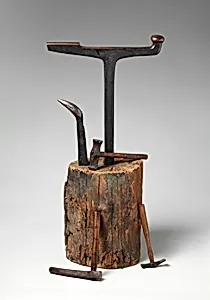
Medium
Iron
Dimensions
H. 29 1/2 in. (74.9 cm); W. of head 21 1/2 in. (54.6 cm); Wt. 39 lb. (17.7 kg)
Classification
Miscellaneous
Culture
German or French
Department
Arms and Armor
Museum
Metropolitan Museum of Art, New York, NY
Credit
Rogers Fund, 1912
Accession Number
12.230.129
Rights
Public Domain
Art Historical Context
Behold the **Armorer's Shaping Stake**, a robust iron tool from the 18th–19th century, likely crafted in Germany or France. Acquired through the Rogers Fund in 1912, this artifact now resides in the Metropolitan Museum of Art's Arms and Armor Department. Standing 29½ inches tall with a broad 21½-inch head and weighing a hefty 39 pounds, it exemplifies the heavy-duty craftsmanship essential to the armorer's trade during an era when plate armor was still valued for ceremonial and parade purposes, even as firearms dominated battlefields. This shaping stake was a vital workbench companion for armorers, used to hammer and form metal sheets into precise curves for breastplates, helmets, or greaves. Its solid iron construction ensured durability under repeated, forceful blows, allowing artisans to achieve the smooth, contoured surfaces that defined high-quality armor. The tool's simple yet masterful forging highlights the blend of functionality and skill in pre-industrial metalworking, where hand tools like this bridged the gap between raw material and wearable art. Though classified as miscellaneous, this stake offers a window into the meticulous world of European arms production, reminding us of the unsung labor behind gleaming suits of armor. Visitors, imagine the rhythmic clang of hammer on stake echoing through a dimly lit forge!