
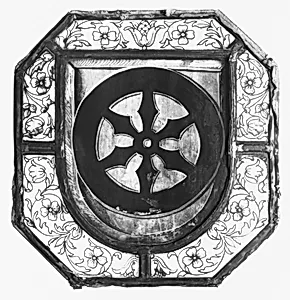
Armorial panel
Unknown Artist
17th century
Medium
Stained glass
Dimensions
Overall: 10 × 10 3/4 in. (25.4 × 27.3 cm)
Classification
Glass-Stained
Culture
German
Department
European Sculpture and Decorative Arts
Museum
Metropolitan Museum of Art, New York, NY
Credit
Bequest of George D. Pratt, 1935
Accession Number
41.170.44
Rights
Public Domain
Tags
Art Historical Context
This exquisite 17th-century German stained glass armorial panel measuring a compact 10 × 10 3/4 inches, the heraldic pride of its era. Crafted by an unknown artist it likely displays a family crest or noble emblem adorned with intricate flowers and leaves—common motifs in armorial designs symbolizing lineage, virtue, and prosperity. Housed in the Metropolitan Museum of Art's European Sculpture and Decorative department, it entered the collection through the generous bequest of D. Pratt in 1935. Stained glass, a medium perfected in medieval Europe but thriving into the Baroque period, involves cutting colored glass sheets, painting details with vitreous enamels, and firing them before assembling with lead strips. In 17th-century Germany, amid religious upheavals and rising secular patronage, such panels graced church windows, guild halls, or private residences, blending artistry with social signaling. This piece's small scale suggests it may have been a bespoke insert for a larger window or a collector's treasure. Its survival offers a glimpse into everyday heraldry, where floral elements evoked growth and heritage. Visitors will appreciate how this vibrant panel, glowing under light, revives the luminous legacy of German craftsmanship.