
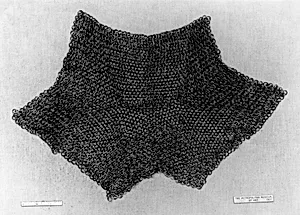
Armpit Defense
Unknown Artist
16th century
Medium
Steel
Dimensions
H. 10 5/8 in. (27.0 cm); W. 9 13/16 in. (25.0 cm); Diam. (outside) of links 3/8 in. (10.0 mm); Diam. (inside) of links 9/32 in. (6.8 mm); Wt. 1 lb. 10.5 oz. (.75 kg)
Classification
Culture
German
Department
Arms and Armor
Museum
Metropolitan Museum of Art, New York, NY
Credit
Gift of Prince Albrecht Radziwill, 1927
Accession Number
27.183.34
Rights
Public Domain
Art Historical Context
Step into the riveting world of 16th German arms and armor with the *Armpit Defense*, a piece of steel chainmail designed to safeguard one of the body's most vulnerable spots. Crafted in Germany during the Renaissance era, when plate armor dominated European battlefields, this flexible mail insert allowed knights crucial mobility in the armpit joint—where rigid plates couldn't bend without compromising protection. Measuring just 10 5/8 inches high and weighing a mere 1 lb. 10.5 oz., its compact form highlights the ingenuity of medieval engineers balancing defense with dexterity. The artistry lies in its exquisite construction: thousands of precisely forged steel rings, each with an outer diameter of 3/8 inch and inner of 9/32 inch, interlocked in a riveted pattern typical of high-end German mail. This fine gauge ensured lightweight yet impenetrable coverage against slashes and thrusts, reflecting the peak of armorer's skill in the Holy Roman Empire. Such pieces were essential for elite warriors, underscoring armor's evolution from crude chain to sophisticated hybrids. A generous gift to the Metropolitan Museum of Art from Prince Albrecht Radziwill in 1927, this artifact invites us to ponder the human cost of chivalry—protection born of peril, where every link told a story of survival.