
Around the Kotatsu
c. 1789
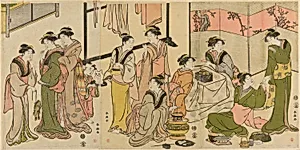
Medium
Color woodblock print; oban triptych
Dimensions
Each sheet approx: 38.4 × 26.2 cm (12 3/4 × 8 3/8 in.)
Classification
woodblock print
Department
Arts of Asia
Museum
Art Institute of Chicago
Accession Number
22045
Rights
Public Domain
Art Historical Context
**Around the Kotatsu** is a captivating color woodblock print triptych by Katsukawaunchô, created around 1789. This oban-sized work—comprising three sheets, each measuring approximately 38.4 × 26.2 cm—exemplifies the vibrant ukiyo-e tradition of Japan's Edo period. Shunchô, a master of the Katsukawa school was renowned for his elegant depictions of beautiful women (bijin-ga) and genre scenes, blending graceful figures with everyday settings. The title evokes a cozy gathering around a kotatsu, the traditional low table shrouded in a quilt over a heat source, a staple of Japanese winter life symbolizing warmth and domestic harmony. As a polychrome woodblock print, the artwork showcases the meticulous ukiyo-e technique: carvers and printers used multiple wooden blocks, inked in nuanced colors like vermilion, indigo, and gold accents, to achieve stunning registration and depth. Produced during the genre's golden age, when affordable prints democratized art for urban audiences in Edo (modern Tokyo), it captures the "floating world" of leisure and human connection amid seasonal rituals. Housed in the Art Institute of Chicago's Arts of Asia department, this triptych invites visitors to ponder Japan's cultural emphasis on communal intimacy. Shunchô's fluid lines and subtle expressions highlight the artistry of ordinary moments, making it a window into 18th-century life. (198 words)
About the Artist
Katsukawa Shunchô · 1780–1801
Katsukawa Shunchō was a Japanese designer of ukiyo-e woodblock prints active from approximately 1780 to 1795, one of the most graceful practitioners of the art of bijinga — pictures of beautiful women. He trained in the studio of Katsukawa Shunshō, the founding master of the Katsukawa School, whose pupils also included the young Hokusai. Shunshō's school was primarily known for realistic portraits...