
Arrow point
Unknown Artist
664–525 BC
Medium
Bronze or copper alloy
Dimensions
L. 3.4 × W. 1.1 cm (1 5/16 × 7/16 in.)
Classification
Arrow point
Period
Late Period
Department
Egyptian Art
Museum
Metropolitan Museum of Art, New York, NY
Credit
Museum Accession
Accession Number
O.C.2057k
Rights
Public Domain
Art Historical Context
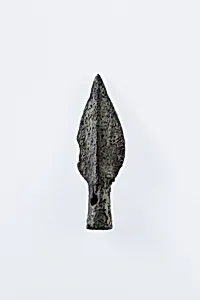
This slender arrow point, crafted from bronze or copper alloy during Egypt's Late Period (Dyn 26, ca. 664–525 BC), exemplifies the practical artistry of ancient Egyptian weapon-making. Measuring just 3. cm long and 1.1 cm wide, its compact, leaf-shaped form was designed for deadly precision when launched from a composite bow—a staple of Egyptian archery. Produced under the Saite dynasty, a time of political reunification and military resurgence after centuries of fragmentation, such points armed soldiers in campaigns against invaders and rivals. The choice of bronze or copper alloy marked a technological leap from softer pure copper, offering greater durability and sharpness for piercing armor or foes. Egyptian metalworkers likely cast or hammered these alloys using lost-wax techniques or simple molds, honing skills passed down through generations. Though mass-produced for warfare, the arrowhead's elegant taper reflects the culture's blend of utility and finesse, underscoring archery's role in pharaonic power—from hunting sacred game to defending the Nile's borders. Today, at the Metropolitan Museum of Art, this unassuming artifact evokes the grit of ancient battles and the ingenuity of a civilization that balanced conquest with cosmic order. A tiny testament to Dynasty 26's revival of Egypt's martial traditions.