
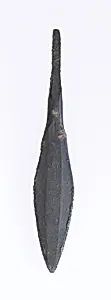
Arrowhead
Unknown Artist
ca. 1550–1458 B.C.
Medium
Copper alloy
Dimensions
L. 9.2 cm (3 5/8 in)
Classification
Arrowhead
Period
New Kingdom
Department
Egyptian Art
Museum
Metropolitan Museum of Art, New York, NY
Credit
Rogers Fund, 1916
Accession Number
16.10.460
Rights
Public Domain
Art Historical Context
This finely crafted arrowhead, dating to the early New Kingdom (ca. 1550–1458 B.C.) during Dynasty 18, hails from a golden age of Egyptian power and innovation. The New Kingdom marked Egypt's imperial expansion under pharaohs like Those I, with military campaigns into Nubia and the Levant relying on advanced weaponry. At just 9.2 cm long, this copper alloy projectile exemplifies the era's sophisticated archery, essential for both hunting warfare in a society where the bow symbolized royal might and divine protection. Forged from copper alloy—a precursor to true bronze—this arrowhead highlights Egypt's early mastery of metallurgy. Artisans likely cast or hammered the metal into a sharp, socketed form to fit wooden shafts, ensuring aerodynamic precision and lethal impact. Such tools were mass-produced in royal workshops, underscoring the state's organized arsenal production. Today, housed in the Metropolitan Museum of Art's Egyptian Art collection (acquired via the Rogers Fund in 1916), this unassuming artifact whispers tales of ancient battles and technological prowess, reminding us how everyday objects fueled one of history's greatest civilizations.