
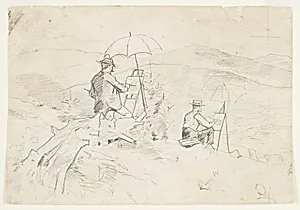
Artists Sketching in the White Mountains
Classification
figures
Department
Smithsonian Collection
Museum
Smithsonian American Art Museum
Credit
Gift of Charles Savage Homer, Jr.
Accession Number
1912-12-263
Rights
Public Domain
About this artwork
Research in Progress
Art Historical Context
Winslow Homer's *Artists Sketching in the Mountains* (1868) captures a serene moment in New Hampshire's rugged landscape, where fellow artists pause to draw en plein air. Created just three years after the Civil War end, this work reflects Homer's growing fascination with the American wilderness as a source of renewal and national identity. Born in Boston in 1836, Homer had risen from a commercial illustrator to a leading realist painter, influenced by the Hudson River School distinguished by his direct, unromanticized observation of nature and everyday life. The painting's focus on figures—artists at work amid majestic peaks—highlights the 19th-century surge in landscape tourism and the Barbizon-inspired trend of outdoor sketching. Homer himself frequented the White Mountains, using such scenes to hone his skills in depicting light, atmosphere, and human activity with bold, economical lines. Though the medium remains unidentified, its classification as a figure study underscores Homer's mastery of capturing transient moments, bridging studio precision with fieldwork spontaneity. Housed in the Smithsonian American Art Museum as a gift from Homer's family, this piece offers a glimpse into the artistic community that shaped American realism. It invites visitors to ponder how such sketches fueled the era's visual chronicle of a healing nation.