
As (Coin) Portraying Agrippa
14-37 or 37-41?
Medium
Bronze
Dimensions
Diam.: 3 cm (1 3/16 in.)
Classification
coin
Department
Arts of Greece, Rome, and Byzantium
Museum
Art Institute of Chicago
Accession Number
78582
Rights
Public Domain
About this artwork
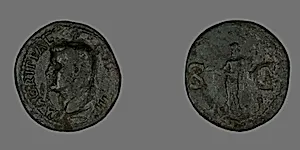
The front (obverse) of this coin portrays the head of Agrippa, facing left. The back (reverse) depicts the god Neptune (Greek Poseidon).
Art Historical Context
This small bronze *as* coin, measuring just 3 cm in, offers a fascinating glimpse into ancient Roman imperial propaganda and portraiture. Struck in the early 1st century CElikely between 14–37 CE under Emperor Tiberius or 3741 CE under Calig—it features the likeness of Marcus Vipsani Agrippa, the brilliant general and close ally of Augustus who helped secure Rome's empire through military victories and engineering feats like the Pantheon. Though Agrippa died in 12 BCE, his image on coins honored his enduring legacy, often posthumously deified alongside imperial family members. As a common denomination in Roman bronze coinage, the *as* circulated widely among everyday people, serving not just as currency but as a medium for political messaging. The obverse likely depicts Agrippa's realistic profile—a hallmark of Roman numismatic art, evolving from Greek influences toward individualized, lifelike portraits that conveyed authority and divinity. Techniques involved striking metal blanks with engraved dies, capturing fine details like hair, facial features, and imperial regalia in miniature scale. Housed in the Art Institute of Chicago's Arts of Greece, Rome, and Byzantium department, this coin underscores how Romans used portable art to foster loyalty and memory across the empire. It's a tiny testament to Agrippa's outsized influence, bridging daily life with the grandeur of Rome's power.
About the Artist
Ancient Roman
The artists attributed to "Ancient Roman" in museum collections represent the anonymous craftsmen who produced the vast output of sculpture, frescoes, mosaics, and reliefs defining Roman visual culture from the Republic (c. 509–27 BCE) to the late Empire (c. 395 CE). Individual identities remain elusive, as Roman makers were typically viewed as skilled tradesmen—often enslaved Greeks or provincial...