
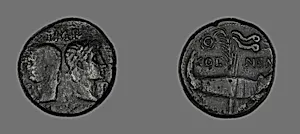
As (Coin) Portraying Augustus and Agrippa
20 BCE-14 CE
Medium
Bronze
Dimensions
Diam.: 2.7 cm (1 1/8 in.)
Classification
coin
Department
Arts of Greece, Rome, and Byzantium
Museum
Art Institute of Chicago
Accession Number
142687
Rights
Public Domain
About this artwork
The front (obverse) of this coin portrays the heads of Agrippa and Augustus, back to back. The back (reverse) shows an alligator facing right, chained to a palm tree with banners and a wreath above.
Art Historical Context
Step into the world of ancient Rome with this bronze *as*, a coin struck between 20 BCE and 14 CE, measuring just 2.7 cm in diameter. Produced during reign of Emperor Augustus—the first Roman emperor—this everyday currency features portraits of Augustus and his trusted ally, Marcus Vipsaniusppa. As a common denomination, the *as* circulated widely among the Roman populace, blending utility with imperial propaganda. Augustus, born Gaius Octavius, transformed Rome from republic to empire after triumphs like the Battle of Actium in 31 BCE. Agrippa, his brilliant general and son-in-law, played a pivotal role in military victories and infrastructure projects, such as the Pantheon. Their joint depiction on this coin underscores their unbreakable partnership, symbolizing stability and power during the early Principate—a time when coins became masterful tools for disseminating the emperor's image and legitimacy across the vast empire. Crafted using precise die-striiking techniques, this bronze piece exemplifies Roman numismatic artistry: realistic, individualized portraits that advanced portraiture traditions inherited from Greek influences. Housed in the Art Institute of Chicago's Arts of Greece, Rome, and Byzantium department, it offers a tangible glimpse into how ancient Romans wielded small metal discs to shape public perception and cultural identity.
About the Artist
Ancient Roman
The artists attributed to "Ancient Roman" in museum collections represent the anonymous craftsmen who produced the vast output of sculpture, frescoes, mosaics, and reliefs defining Roman visual culture from the Republic (c. 509–27 BCE) to the late Empire (c. 395 CE). Individual identities remain elusive, as Roman makers were typically viewed as skilled tradesmen—often enslaved Greeks or provincial...