
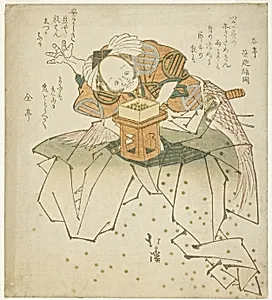
Asahina Saburo throwing beans
n.d.
Medium
Color woodblock print; shikishiban, surimono
Dimensions
20.6 × 18.5 cm (8 1/8 × 7 5/16 in.)
Classification
woodblock print
Department
Arts of Asia
Museum
Art Institute of Chicago
Accession Number
81097
Rights
Public Domain
Art Historical Context
Behold the vibrant *Asahina Saburo Th Beans*, a color woodblock print by Tot Hokkei, a masterful ukiyo-e artist pupil of the legendary Katsushika Hokusai. Active in early 19th-century Japan the late Edo period, Hokkei specialized in surimono—luxurious, privately commissioned prints often produced for New Year's celebrations. This shikishiban format, compact square measuring about 8 by 7 inches, exemplifies the intimate elegance of such works, perfect for personal albums or gifts. The scene captures the warrior Asahina Saburo, a heroic figure from Japanese folklore rooted in the Genpei War tales, mid-action hurling beans during Setsubun, the traditional festival marking winter's end. On this occasion, families toss roasted soybeans to exorcise evil spirits (oni) and invite good fortune, chanting "Demons out, fortune in!" Hokkei's dynamic composition, with bold colors layered through meticulous woodblock carving and printing, brings the ritual's playful energy to life, blending historical legend with everyday custom. Hokkei's technique shines in the subtle gradients (bokashi) and metallic accents typical of surimono, showcasing ukiyo-e's pinnacle of craftsmanship. Housed in the Art Institute of Chicago's Arts of Asia collection, this undated gem offers a window into Edo-period popular culture, where art joyfully intertwined myth, theater, and seasonal rites.
About the Artist
Totoya Hokkei · 1780–1850
Totoya Hokkei (魚屋 北渓, 1780–1850), born Iwakubo Tatsuyuki in Edo (modern Tokyo), began his life as a humble fishmonger in the Yotsuya Samegahashi district, a trade reflected in his art name "Totoya," meaning fish shop. He transitioned to art through rigorous training, first studying under Kanō Yōsen'in Korenobu, head of the Kobikichō branch of the prestigious Kanō school, where he honed landscape p...