
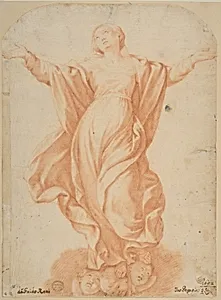
Assumption of the Virgin
1575–1642
Medium
Red chalk
Dimensions
10 1/2 × 7 5/8 in. (26.7 × 19.4 cm)
Classification
Drawings
Department
Drawings and Prints
Museum
Metropolitan Museum of Art, New York, NY
Credit
Gift of Cephas G. Thompson, 1887
Accession Number
87.12.24
Rights
Public Domain
Tags
Art Historical Context
Guido Reni’s *Assumption of the Virgin* is a delicate red-chalk drawing that captures one of the most beloved subjects in Christian art: the moment when the Virgin Mary is taken bodily into heaven. Created during Reni’s lifetime (1575–1642), the sheet belongs to the rich tradition of Italian Baroque draftsmanship, when artists used quick, expressive studies to work out compositions for large altarpieces and frescoes. Red chalk, prized for its warm tone and ability to render soft transitions of light and shadow, allowed Reni to model the Virgin’s upward gaze and the swirling drapery of attendant angels with remarkable subtlety. Such drawings were rarely intended for public view; instead they reveal the artist’s private process as he refined poses and movement before transferring the design to canvas or plaster. Today the sheet offers visitors an intimate glimpse into the working methods of one of the leading painters of seventeenth-century Bologna. Its presence in the Metropolitan Museum’s collection, given in 1887, underscores the enduring value of these preparatory works as independent works of art in their own right.
About the Artist
Guido Reni · 1575–1642
Guido Reni (1575–1642) was one of the most celebrated Italian painters of the Baroque era and the dominant figure of the Bolognese School. Born into a family of musicians in Bologna, he trained first with Denys Calvaert before joining the influential Accademia degli Incamminati led by Ludovico Carracci. Reni achieved international fame through his idealizing style that combined Baroque dynamism wi...