
Astroloog
1626 - 1659
Medium
etching
Dimensions
94; 126
Rights
Public Domain
About this artwork
ets en droge naald
Art Historical Context
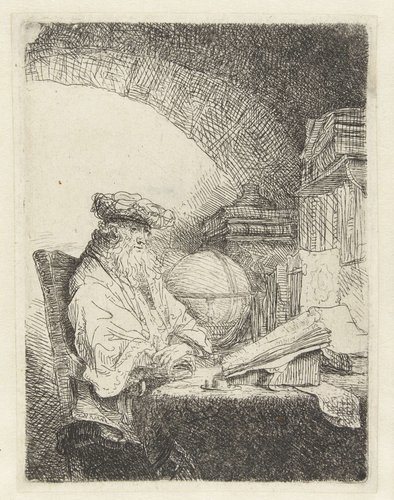
Ferdinand Bol's *Astroloog* (Astrologer), created sometime between 1626 and1659, captures the enigmatic world of 17th-century during the Dutch Golden Age., a talented pupil of Rembrandt, was renowned for his portraits and history paintings, but this etching showcases his skill as a printmaker. The small-scale work (126 × 94 mm) depicts an astrologer intently studying celestial charts, reflecting the era's blend of science, mysticism, and intellectual curiosity amid the Scientific Revolution. Rendered in etching combined with drypoint—a technique noted as "ets en droge naald" in Dutch—the print demonstrates Bol's mastery of intaglio methods. Etching allows for precise, fluid lines etched into a metal plate with acid, while drypoint adds a soft, velvety texture from the burr raised by a sharp tool. This combination creates rich tonal depth and subtle modeling, making the intimate image ideal for collectors and scholars. In a time when astrology bridged astronomy and the occult, *Astroloog* symbolizes the Dutch fascination with knowledge seekers. Bol's Rembrandt-influenced chiaroscuro enhances the figure's contemplative mood, inviting viewers to ponder the stars' influence on human fate. A gem of Baroque printmaking, it highlights Bol's versatility beyond canvas.
About the Artist
Ferdinand Bol · 1616–1680
As a very young man, Bol moved to Amsterdam, where he worked under the direction of Rembrandt, with whom he formed a friendship. Comment on works: Religious; History; Portraits