
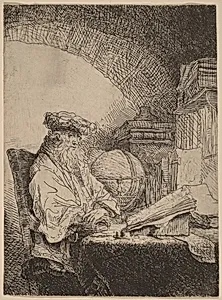
The Astrologer
1601 to 1650
Medium
etching
Dimensions
sheet (trimmed to plate mark): 12.6 x 9.3 cm (4 15/16 x 3 11/16 in.)
Classification
Department
CG-E
Museum
National Gallery of Art, Washington, D.C.
Credit
Rosenwald Collection
Accession Number
1943.3.1504
Rights
Public Domain
Art Historical Context
Behold *The Astrologer*, a delicate etching by Ferdinand Bol, a prominent Dutch artist of the Baroque era and a favored pupil of Rembrandt van Rijn. Created sometime between 1601 and1650—likely during Bol's early career in the 1640s—this intimate print measures just 12.6 x 9.3 cm, trimmed to the plate mark, making it a pocket-sized gem suited for collectors of the Dutch Golden Age. Housed in the National Gallery Art's Rosenwald Collection (Department CG-E), it exemplifies the era's fascination with intellectual pursuits, portraying an astrologer amid the blend of emerging science and lingering mysticism in 17th-century Europe. Etching, Bol's chosen medium here, allowed for intricate, fluid lines etched into a metal plate with acid, producing rich tonal contrasts and subtle textures reminiscent of Rembrandt's influence. Bol produced only a handful of such prints, prized for their technical finesse and atmospheric depth, which capture personality and narrative in miniature form. This technique democratized art, enabling wider dissemination of sophisticated imagery beyond oil paintings. Culturally, *The Astrologer* reflects the Dutch Republic's intellectual curiosity—astrology hovered between forbidden pseudoscience and scholarly inquiry, often depicted in genre scenes to evoke wonder or wry commentary. A testament to Bol's versatility before he rose to fame as a portraitist, this work invites visitors to ponder the stars through a master's gaze.
About the Artist
Ferdinand Bol · 1616–1680
As a very young man, Bol moved to Amsterdam, where he worked under the direction of Rembrandt, with whom he formed a friendship. Comment on works: Religious; History; Portraits