
Astronomicum Caesareum
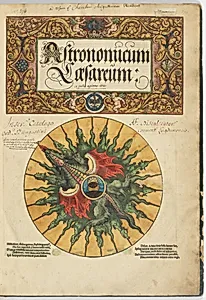
Medium
Hand-colored woodcuts
Dimensions
17 7/8 × 12 11/16 × 1 5/16 in. (45.4 × 32.3 × 3.3 cm)
Classification
Books
Department
Drawings and Prints
Museum
Metropolitan Museum of Art, New York, NY
Credit
Gift of Herbert N. Straus, 1925
Accession Number
25.17
Rights
Public Domain
Tags
Art Historical Context
Step into the cosmos with *Astronomicum Caesare*, a stunning 1540 astronomical atlas crafted by scholar Petrus Apianus, brother Georg Apianus, engraver Michael Ostendorfer. Produced Ingolstadt, this lavish book—measuring about 18 by 13 inches—was dedicated to Holy Roman Emperor Charles V, Renaissance science and artistry. As one of the era's most ambitious printed works, it features intricate hand-colored woodcuts depicting celestial phenomena, planetary motions, and volvelles—ingenious rotating paper dials for calculating positions of stars and planets. The medium of hand-colored woodcuts was revolutionary: woodblocks enabled precise, reproducible diagrams, while meticulous coloring by skilled artisans elevated it to a collector's treasure, symbolizing the fusion of empirical observation and imperial patronage during the Scientific Revolution. Apianus, a pioneering cartographer and astronomer, used these visuals to demystify the heavens, making complex ephemerides accessible to scholars and rulers alike. Today, housed in The Metropolitan Museum of Art's Drawings and Prints department (gift of Herbert N. Straus, 1925), *Astronomicum Caesareum* captivates as a testament to 16th-century ingenuity, where art illuminated the stars and bridged medieval astrology with modern astronomy.