
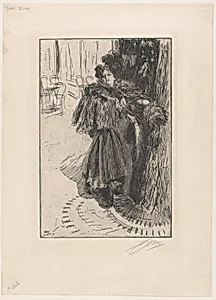
At Night III
1897
Medium
Etching; second state of three (Asplund)
Dimensions
Plate: 4 in. × 7 7/8 in. (10.1 × 20 cm) Sheet: 17 3/8 × 12 1/2 in. (44.1 × 31.7 cm)
Classification
Prints
Department
Drawings and Prints
Museum
Metropolitan Museum of Art, New York, NY
Credit
Harris Brisbane Dick Fund, 1917
Accession Number
17.3.724
Rights
Public Domain
Tags
Art Historical Context
Anders Zorn's *At Night III* (1897) is a masterful etching from Swedish artist's prolific printmaking phase, capturing the intimate allure of women in nocturnal settings. Zorn (1860–1920), celebrated for his luminous portraits and nudes, drew inspiration from everyday life, often infusing his works with a sensual, naturalistic glow. This second state of three—referenced in the Asplund catalogue raisonné—showcases his evolving process, where subtle refinements enhanced depth and texture before the final edition. Rendered on a modest plate (4 × 7⅞ inches), the etching exemplifies Zorn's virtuoso drypoint technique, blending fine lines with rich burrs to evoke moonlight on skin and shadow. Etchings like this were revolutionary in the late 19th century, democratizing his oil paintings' realism through affordable prints. Tags evoking "Women" and "Night" hint at the series' poetic exploration of femininity and mystery, a motif Zorn revisited to highlight vulnerability and beauty amid darkness. Acquired via the Harris Brisbane Dick Fund in 1917 for the Metropolitan Museum of Art's Drawings and Prints department, *At Night III* endures as a testament to Zorn's international acclaim, bridging Scandinavian realism with European impressionistic light effects. Visitors will appreciate its delicate intimacy, inviting quiet reflection on the night's subtle revelations.
About the Artist
Anders Zorn · 1860–1920
Anders Zorn (1860–1920), one of Sweden's most celebrated artists, was born on February 18 in Utmeland near Mora in Dalarna, and raised on his maternal grandparents' farm in the nearby hamlet of Yvraden. Displaying prodigious talent from a young age, he attended school in Mora Strand until age twelve, followed by secondary grammar school in Enköping, where he excelled in drawing people and horses. ...