
At the Café (Au café)
1869
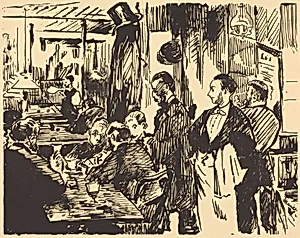
Medium
lithograph printed in black
Dimensions
image: 26.3 x 33.4 cm (10 3/8 x 13 1/8 in.) sheet: 31 x 43.9 cm (12 3/16 x 17 5/16 in.)
Classification
Department
CG-E
Museum
National Gallery of Art, Washington, D.C.
Credit
Rosenwald Collection
Accession Number
1953.6.82
Rights
Public Domain
Art Historical Context
Édouard Manet's *At the Café (Au café)*, created in 1869, the vibrant social life of Second Empire Paris through the lens of a bustling café scene. As a pioneer of modern art, Manet bridged Realism and Impressionism, often contemporary urban leisure with unflinching directness. This lithograph printed in black ink on a modest sheet measuring 31 x 43.9 cm, reflects the everyday haunts of Parisians, where café culture flourished as a hub for conversation, flirtation, and observation—mirroring the artist's fascination with modern manners. Printed from a stone using lithography, a technique Manet mastered for its fluid lines and tonal subtleties, the work exemplifies his innovative approach to printmaking. Unlike traditional paintings, lithographs allowed for broader dissemination, making art accessible beyond elite salons. Housed in the National Gallery of Art's Rosenwald Collection (Department CG-E), this piece highlights Manet's technical prowess in achieving painterly effects through bold contrasts and implied depth, even in monochrome. Today, *At the Café* invites visitors to ponder the cultural shift toward public sociability in 19th-century France, where such scenes challenged academic norms and paved the way for Impressionist spontaneity. A testament to Manet's enduring influence, it reminds us how a simple café tableau can encapsulate an era's spirit.
About the Artist
Edouard Manet · 1832–1883
Édouard Manet (1832-1883) was a French painter who played a pivotal role in the transition from Realism to Impressionism, often called the 'Father of Modern Art.' Born into a wealthy Parisian family, Manet defied his father's wishes for a legal career to pursue painting, studying under academic artist Thomas Couture. His revolutionary works 'Le Déjeuner sur l'herbe' and 'Olympia' (both 1863) scand...