
"At the Railroad Station"
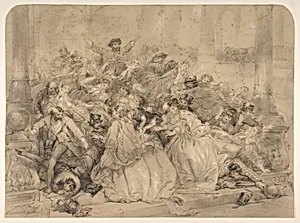
Medium
Graphite, black and red chalk, heightened with white
Dimensions
12 3/8 x 16 3/4 in. (31.4 x 42.6 cm) Top corners rounded.
Classification
Drawings
Department
Drawings and Prints
Museum
Metropolitan Museum of Art, New York, NY
Credit
The Elisha Whittelsey Collection, The Elisha Whittelsey Fund, 1958
Accession Number
58.512.1
Rights
Public Domain
Tags
Art Historical Context
In the mid-19th century, Pierre-Numa Bassaget, known simply as Numa, captured the thrill of modernity in his drawing *At the Railroad Station* (1850–59). This lively scene depicts a bustling crowd of men and women at a train platform, evoking the excitement and chaos of Europe's burgeoning rail network. Created during a transformative era when railroads revolutionized travel and commerce—France's lines expanded dramatically in the 1850s—Numa's work offers a vivid snapshot of everyday life amid industrial progress, before photography fully dominated such documentation. Rendered in graphite, black and red chalk heightened with white on paper (12 3/8 x 16 3/4 in.), the drawing showcases virtuoso mixed-media techniques. Graphite provides precise lines for architectural details and figures, while chalks add rich tonal modeling and volume. The white heightening creates dramatic light effects, illuminating the dynamic crowd against the station's structure. Such preparatory-style drawings were prized in 19th-century France for their spontaneity and realism, blending observation with artistic flair. Today, housed in the Metropolitan Museum of Art's Elisha Whittelsey Collection, *At the Railroad Station* invites visitors to ponder how 19th-century innovations reshaped society, freezing a moment of collective anticipation in delicate, enduring lines.