
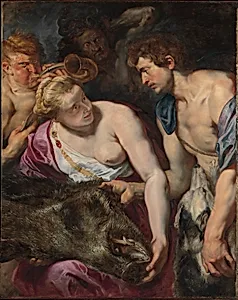
Atalanta and Meleager
ca. 1616
Medium
Oil on wood
Dimensions
52 1/2 x 42 in. (133.4 x 106.7 cm)
Classification
Paintings
Department
European Paintings
Museum
Metropolitan Museum of Art, New York, NY
Credit
Fletcher Fund, 1944
Accession Number
44.22
Rights
Public Domain
Tags
Art Historical Context
Peter Paul Rubens’s *Atalanta and Meleager* captures a dramatic moment from the ancient Greek myth of the Calydonian boar hunt. Painted around 1616 in oil on wood, the work shows the skilled huntress Atalanta alongside the heroic Meleager as they confront the fearsome boar, accompanied by eager hounds. Rubens, the leading Flemish Baroque master, infused such mythological scenes with dynamic movement and rich color, reflecting his deep study of Italian Renaissance art during his travels. The subject draws from Ovid’s *Metamorphoses*, a favorite source for seventeenth-century artists. Rubens often chose tales of adventure and emotion to showcase the human form in action, using vigorous brushwork and luminous flesh tones to heighten the sense of excitement and physical power. The sturdy oak panel support was typical of Northern European practice, allowing fine detail while withstanding the test of time. Today in the Metropolitan Museum’s European Paintings galleries, the canvas stands as a vivid example of Baroque storytelling—inviting viewers to feel the thrill of the chase and the timeless appeal of classical legend.
About the Artist
Peter Paul Rubens · 1577–1640
Peter Paul Rubens (1577-1640) stands as the most influential artist of the Flemish Baroque tradition and the greatest exponent of Baroque painting's dynamism, vitality, and sensuous exuberance. Born in Siegen, Westphalia, and raised in Antwerp, Rubens received a humanist education studying Latin and classical literature before pursuing artistic training under three masters: Tobias Verhaecht, Adam ...