
Ate and the Litai
1535–46
Medium
Bronze, dark brown patina.
Dimensions
Diam. 5 3/4 in. (14.6 cm.)
Classification
Medals and Plaquettes
Culture
German, Nuremberg
Department
European Sculpture and Decorative Arts
Museum
Metropolitan Museum of Art, New York, NY
Credit
Rogers Fund, 1954
Accession Number
54.84
Rights
Public Domain
Tags
Art Historical Context
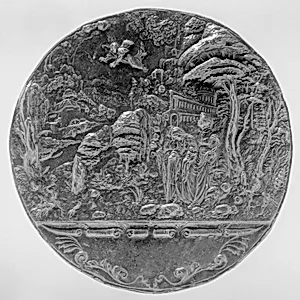
Peter Flötner’s *Ate and the Litai* (1535–46) is a captivating bronze plaquette from Renaissance Nuremberg, a hub of German artistic innovation. Measuring just 5¾ inches in diameter, this-scale relief captures a dramatic moment from Greek mythology: Ate, the goddess of delusion and mischief, flees as the Litai—personifications of Prayers—pursue her in supplication. Flötner, a versatile Nuremberg artist known for his designs in metalwork, woodcuts, and ornamentation, draws on classical sources like Homer’s *Iliad* to blend Northern Renaissance precision with humanist reverence for antiquity. The scene’s figures—men and women amid a hinted landscape—evoke moral lessons on hubris and repentance, popular themes in the era’s intellectual circles. Crafted in bronze with a rich dark brown patina, the plaquette exemplifies the technical mastery of Nuremberg goldsmiths, who excelled in casting intricate low-relief sculptures. These portable “medals and plaquettes” were prized by collectors as affordable alternatives to paintings or sculptures, serving as conversation pieces that showcased erudition. Flötner’s style reflects Italian influences filtered through German realism, with finely detailed drapery and expressive poses that heighten the narrative tension. Acquired by The Metropolitan Museum of Art through the Rogers Fund in 1954, this work highlights Nuremberg’s role in bridging Gothic traditions and the Renaissance, inviting visitors to ponder timeless vices and the hope of redemption in a remarkably intimate format.
About the Artist
Peter Flötner · 1485–1546
Peter Flötner (c. 1485–1546) was a German sculptor, ornament designer, and medalist whose work played a central role in the transmission of Italian Renaissance decorative vocabulary into the German-speaking lands. Though his exact origins remain uncertain — he may have trained in Augsburg before settling permanently in Nuremberg around 1522 — his formation evidently included exposure to Italian Re...