
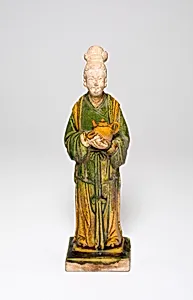
Attendant Holding a Teapot
Ming dynasty (1368–1644)
Medium
Glazed earthenware
Dimensions
18.1 × 5.4 × 5.2 cm (7 1/8 × 2 1/8 × 2 1/16 in.)
Classification
statuette
Department
Arts of Asia
Museum
Art Institute of Chicago
Accession Number
12198
Rights
Public Domain
Art Historical Context
This delicate glazed earthenware statuette, titled *Attendant Holding a Te*, hails from China's Ming dynasty (13681644), a golden age of artistic refinement and cultural splendor. Standing just 18.1 cm tall, the figure depicts a poised servant cradling a teapot, the everyday grace of domestic life. Crafted as a small-scale model, it exemplifies the Ming era's mastery of ceramics, where artisans produced intricate objects for both utilitarian and ceremonial purposes. The use of glazed earthenware highlights innovative firing techniques that yielded vibrant, durable surfaces, often in earthy tones or subtle polychromy. Such statuettes, classified as mingqi (spirit objects), were commonly placed in tombs to serve the deceased in the afterlife, reflecting Confucian ideals of harmony and hierarchy. The teapot in the attendant's hands nods to the Ming dynasty's burgeoning tea culture, as leaf tea and refined brewing rituals gained popularity among the elite. On view in the Arts of Asia department at the Art Institute of Chicago, this anonymous work invites us to ponder the artistry of unnamed makers whose skill brought intangible routines to vivid, enduring life.
About the Artist
Unknown
The artist designated as "Unknown" in our virtual museum's collection exemplifies a poignant chapter in art history: creators whose identities have faded into obscurity despite the enduring power of their work. With only one known artwork attributed to them in our holdings, this figure represents countless anonymous hands that shaped visual culture across centuries. Museums worldwide, including th...