
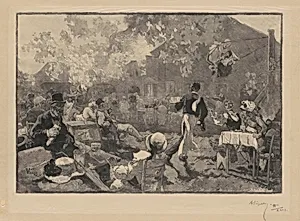
Au coq du brûyeres
Medium
wood engraving
Classification
Department
CG-E
Museum
National Gallery of Art, Washington, D.C.
Credit
Corcoran Collection (Gift of Jack and Margrit Vanderryn)
Accession Number
2015.19.3236
Rights
Public Domain
Art Historical Context
"**Au coq du bruyères** (1888) is a captivating wood engraving by French artist Auguste Lepère, after an original design by the renowned Spanish illustrator Daniel Urrieta y Vierge, known simply as Daniel Vierge. This print, housed in the National Gallery of's Corcoran Collectiongift of Jack and Marit Vanderryn), exemplifies late 19th-century with illustrative printmaking in France, where wood engravings bridged fine art and mass reproduction. Wood engraving, Lepère's specialty, involved incising fine lines into the hard end-grain of boxwood blocks, allowing for intricate details and tonal effects that mimicked drawing. Lepère, a master of this technique, often captured rural French scenes with a naturalistic vigor influenced by the Realist and Impressionist movements. Here, working from Vierge's dynamic composition—famous for his bold, expressive style in periodicals like *Gil Blas*—Lepère translates a likely pastoral or village motif into a precise, reproducible image, highlighting the collaborative spirit of the era's graphic arts. This piece reflects the cultural shift toward accessible art through prints, popular in books and journals. Its presence in the CG-E Print Department underscores its technical prowess and historical role in documenting everyday life, inviting visitors to appreciate the enduring craft of 1880s engraving. (198 words)