
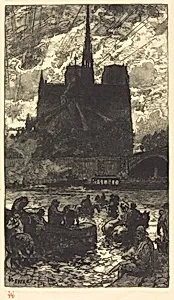
Watering-place behind Notre-Dame (L'abreuvoirderriere Notre-Dame)
1897
Medium
wood engraving
Classification
Department
CG-E
Museum
National Gallery of Art, Washington, D.C.
Credit
Rosenwald Collection
Accession Number
1943.3.5573
Rights
Public Domain
Art Historical Context
Nestled behind the iconic Notre-Dame Cathedral in Paris,Watering-place behind Notre-DameL'abreuvoir derrière Notre-Dame)* (1897) by Auguste Lepère captures a slice of everyday urban life in fin-de-siècle France.ère, a renowned French engraver and illustrator (1849–1918), specialized in meticulous depictions of Parisian streets and architecture, blending realism with a poetic eye for the ordinary. This engraving portrays a humble watering trough—likely used by horses and locals—framed by the Gothic silhouette of Notre-Dame, evoking the bustling yet timeless rhythm of the city around 1900. Wood engraving, Lepère's preferred medium, allowed for extraordinary detail and tonal depth, as the artist carved directly into the end-grain of wood blocks, which were then printed like intaglio. This technique, peaking in the 19th century before photomechanical processes dominated, highlighted the engraver's craftsmanship and was ideal for reproducing intricate urban scenes in books and periodicals. Lepère's works often appeared in publications like *Le Monde Illustré*, making art accessible to a wide audience. Housed in the National Gallery of Art's Rosenwald Collection—a treasure trove of prints gifted by collector Lessing J. Rosenwald—this piece underscores Lepère's mastery in immortalizing Paris's hidden corners. It invites visitors to linger on the interplay of shadow, stone, and daily toil, reminding us of the city's layered history just steps from its grand landmarks.
About the Artist
Auguste Lepère · 1849–1918
Auguste-Louis Lepère (1849–1918), son of the sculptor François Lepère, was born in Paris on November 30, 1849, into an artistic family that shaped his early path. At age thirteen, he apprenticed in the Paris studio of the English wood engraver Joseph Burn Smeeton, honing his skills in wood engraving until 1867. He furthered his training with drawing classes under Horace Lecoq de Boisbaudran at the...