
Au Valromey
1868
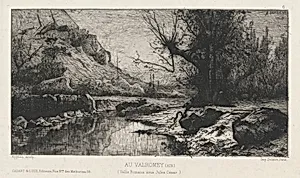
Medium
etching with drypoint on wove paper
Dimensions
image: 10 x 19.1 cm (3 15/16 x 7 1/2 in.) plate: 13.8 x 23.8 cm (5 7/16 x 9 3/8 in.) sheet: 14.2 x 24.2 cm (5 9/16 x 9 1/2 in.)
Classification
Department
CG-E
Museum
National Gallery of Art, Washington, D.C.
Credit
Gift of Gaillard F. Ravenel and Frances P. Smyth-Ravenel
Accession Number
2000.7.1
Rights
Public Domain
Art Historical Context
Adolphe Appian's *Au Valromey* (1868) captures the serene beauty of theromey region in eastern France, a landscape of rolling hills and winding rivers that inspired many 19th-century artists. Appian, a French etcher and painter associated with the Barbizon school, excelled at translating the subtle moods of nature onto paper. This intimate print, measuring just 10 x 19.1 cm in its image area, invites viewers into a tranquil pastoral scene, evoking the Romantic emphasis on the sublime in everyday scenery. Rendered in etching with drypoint on wove paper, the work showcases Appian's mastery of printmaking techniques. Etching allows for precise, fluid lines etched into a metal plate with acid, while drypoint adds a soft, velvety texture from the burr created by direct scratching—resulting in rich tonal contrasts and atmospheric depth. Wove paper's smooth surface enhanced these delicate effects, making it ideal for such fine reproductions during the etching revival of the 1860s. Housed in the National Gallery of Art as a gift from Gaillard F. Ravenel and Frances P. Smyth-Ravenel, *Au Valromey* exemplifies how 19th-century prints democratized access to landscape art, bridging studio painting and intimate collecting. It's a testament to Appian's legacy in celebrating France's natural heritage.
About the Artist
Adolphe Appian · 1818–1898
Adolphe Appian, born Jacques Barthélemy Adolphe Appian in Lyon, France, on August 28, 1819, began his artistic training at the age of fifteen at the École des Beaux-Arts de Lyon. There, he studied under the landscape painters Jean-Michel Grobon and Augustin Alexandre Thierrat, initially focusing on fabric decoration for the city's thriving silk industry. This practical grounding in drawing honed h...