
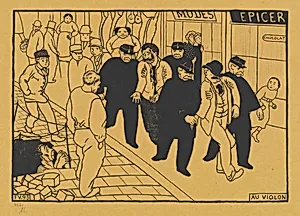
Au Violon (Off to the Jug)
1893
Medium
lithograph (zinc) on yellow wove paper
Dimensions
image: 21.8 x 31.5 cm (8 9/16 x 12 3/8 in.) sheet: 32.7 x 49.7 cm (12 7/8 x 19 9/16 in.)
Classification
Department
CG-E
Museum
National Gallery of Art, Washington, D.C.
Credit
Rosenwald Collection
Accession Number
1952.8.481
Rights
Public Domain
Art Historical Context
Félix Vallotton's 1893 lithograph *Au Violon (Off to the Jug)* captures a moment of everyday drama with quiet irony. The French title plays on slang for being sent to jail, suggesting the scene depicts an arrest or the transport of a prisoner. Printed in zinc lithography on distinctive yellow wove paper, the work exemplifies the late-nineteenth-century revival of printmaking as a modern, democratic art form that could circulate widely beyond the walls of galleries. Vallotton, a Swiss-born artist active in Paris, used the fluid lines and tonal contrasts possible in lithography to distill social observation into a compact, graphic statement. The medium allowed him to explore themes of urban life and human folly with sharp economy, reaching audiences through illustrated journals and affordable editions. The warm yellow paper adds an unexpected glow to the composition, softening the subject while underscoring the print's experimental spirit. Today in the National Gallery of Art's Rosenwald Collection, the sheet remains a vivid example of how artists at the fin de siècle turned ordinary paper and ink into pointed commentary on justice and society. Its modest size invites close looking, rewarding viewers with both visual wit and historical resonance.
About the Artist
Félix Vallotton · 1865–1925
Félix Vallotton (1865–1925) was born in Lausanne, Switzerland, into a comfortable middle-class family, and moved to Paris in 1882 to enroll at the Académie Julian, where he studied under the portrait painter Jules Joseph Lefebvre and the history painter Gustave Boulanger. Paris would remain his home for the rest of his life, and he became a French citizen in 1900 following his marriage to the art ...