
Augustin de Thou
1551 to 1600
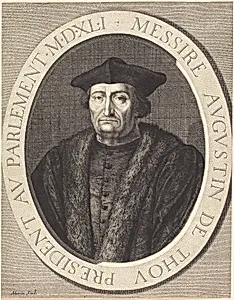
Medium
etching and engraving
Classification
Department
CG-E
Museum
National Gallery of Art, Washington, D.C.
Credit
Ailsa Mellon Bruce Fund
Accession Number
1974.53.19
Rights
Public Domain
Art Historical Context
**Augustin de Thou** is a striking portrait print by the French engraver Jean Morin, created between 1551 and 1600. It depicts Augustin de Thou, prominent 16th-century French magistrate scholar, and historian who served as president of the of Paris. Morin's work captures the intellectual gravitas of Renaissance humanism, reflecting the era's emphasis on classical learning and civic duty amid France's religious wars and cultural flourishing. Crafted through the meticulous techniques of etching and engraving, this print showcases Morin's mastery of line work. Etching allowed for fluid, expressive lines using acid on a prepared plate, while engraving provided precise, intricate details—ideal for conveying the subject's dignified attire and thoughtful expression. As a print, it democratized portraiture, making elite likenesses accessible beyond oil paintings, a key innovation in 17th-century printmaking. Housed in the National Gallery of Art's Prints department (CG-E) through the Ailsa Mellon Bruce Fund, this piece highlights the intersection of politics, scholarship, and art in early modern Europe. Visitors will appreciate how it preserves de Thou's legacy, offering a window into the refined world of French humanism.
About the Artist
Jean Morin · 1605–1650
Jean Morin (c. 1605–1650) was one of the most accomplished French engravers of the seventeenth century, a master of the portrait print whose work stands among the finest examples of French graphic art in its era. Little is known about his early life or training, though his technique suggests exposure to both French and Flemish engraving traditions, the latter being the dominant force in European p...