
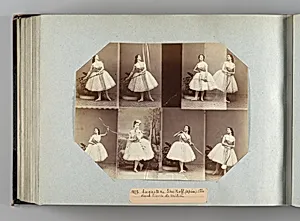
Augustine Stoïkoff dans Pierre de Médicis
Medium
Albumen silver print from glass negative
Dimensions
Image: 7 3/8 × 9 1/4 in. (18.8 × 23.5 cm) Album page: 10 3/8 × 13 3/4 in. (26.3 × 35 cm)
Classification
Photographs
Department
Photographs
Museum
Metropolitan Museum of Art, New York, NY
Credit
Gilman Collection, Gift of The Howard Gilman Foundation, 2005
Accession Number
2005.100.588.1.130
Rights
Public Domain
Art Historical Context
In 1860, French photographer André-Adolpheugène Disdéri *Augustine Stoïk dans Pierre de Médic*, an albumen silver from a glass negative, housed in the Metropolitan Museum of's Gilman Collection. This intimate portrait, measuring about 7⅜ × 9¼ inches, depicts the subject—likely an actress or model—costumed as Pierre de Médis, evoking the Renaissance grandeur of the Medici family.déri's mastery of the medium shines through the print's rich tonal range and fine detail, hallmarks of albumen silver processes that coated paper with egg whites for a glossy, luminous finish. Disdéri revolutionized photography during the Second Empire era by inventing the carte de visite format around 1854—a small, affordable card-mounted portrait that sparked a global craze. By 1860, millions were produced annually, democratizing portraiture for the middle class and celebrities alike. This image exemplifies his commercial genius, blending theatrical flair with historical allusion, as performers like Stoïkoff donned elaborate costumes for the camera. Culturally, the photograph bridges 19th-century spectacle and Renaissance revivalism, reflecting France's fascination with opulent pasts amid Haussmann's modern transformations. A snapshot of innovation, it invites us to ponder how photography preserved fleeting performances for eternity.
About the Artist
André-Adolphe-Eugène Disdéri · 1819–1889
**André-Adolphe-Eugène Disdéri** (1819–1889) was a pioneering French photographer whose innovations transformed portraiture into a mass medium during the Second Empire. Born on March 28, 1819, in Paris, Disdéri pursued diverse careers in commerce, acting, and politics early on, while studying art amid personal hardships following his father's death, which compelled him to support his mother, sibli...