
Augustus the Strong as Roman Emperor
ca. 1728
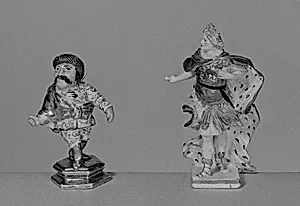
Medium
Hard-paste porcelain
Dimensions
Height: 4 1/4 in. (10.8 cm)
Classification
Ceramics-Porcelain
Culture
German, Meissen
Department
European Sculpture and Decorative Arts
Museum
Metropolitan Museum of Art, New York, NY
Credit
Gift of Irwin Untermyer, 1964
Accession Number
64.101.103
Rights
Public Domain
Tags
Art Historical Context
This exquisite porcelain figurine, *Augustus the Strong as Emperor*, crafted by the Meissen Manufactory 1728, captures the grandeur of Augustus II, Elector of Saxony and King Poland. Standing just 4¼ inches tall, it depicts the flamboyant ruler in the guise of the ancient Roman emperor Augustus, complete with imperial toga and laurel wreath. Meissen, the pioneering German factory established in 1710 under royal patronage, produced Europe's first true hard-paste porcelain, technical marvel that rivaled prized Chinese imports with its translucent durability and fine detail. The artwork reflects Augustus the Strong's larger-than-life persona and his passion for the arts. A lavish collector who filled his Dresden palace with treasures, he personally championed Meissen's development, alchemically seeking the secret of porcelain. By portraying himself as a Roman emperor, the figurine embodies Baroque-era ideals of absolutist power and classical revival, blending historical homage with 18th-century Rococo whimsy in its delicate modeling and vibrant polychrome enamels. As a highlight of European decorative arts, this piece showcases Meissen's mastery of miniature sculpture—intricate gestures, lifelike fabrics, and subtle gilding—all fired at high temperatures for enduring brilliance. Donated to the Metropolitan Museum of Art in 1964, it invites visitors to marvel at the fusion of royal vanity, technical innovation, and cultural prestige that defined early modern Germany.
About the Artist
Meissen Manufactory · 1710–present
The Meissen Manufactory, established on June 6, 1710, by Augustus the Strong, Elector of Saxony and King of Poland, marked the dawn of true hard-paste porcelain production in Europe. Nestled at Albrechtsburg Castle in Meissen near Dresden, the Royal Polish and Electoral Saxon Porcelain Manufactory arose from alchemical experiments begun in 1708 by physicist Ehrenfried Walther von Tschirnhaus and p...