
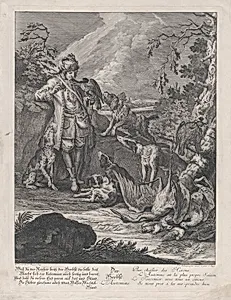
Autumn from the Dog's Four Seasons
1720–1767
Medium
Etching
Dimensions
Plate: 15 15/16 × 13 1/16 in. (40.5 × 33.2 cm) Sheet: 20 1/16 × 15 3/4 in. (51 × 40 cm)
Classification
Prints
Department
Drawings and Prints
Museum
Metropolitan Museum of Art, New York, NY
Credit
The Elisha Whittelsey Collection, The Elisha Whittelsey Fund
Accession Number
58.625.25
Rights
Public Domain
Art Historical Context
Johann Elias Ridinger, a masterful 18th-century German engraver and painter (1698–1767), crafted *Autumn from the Dog's Seasons* during his prolific career spanning 1720–1767. This etching belongs to a whimsical series that personifies the seasons through dogs, blending Baroque naturalism with playful anthropomorphism. Ridinger, celebrated for his meticulous depictions of animals—especially horses, hounds, and hunting scenes—captured the essence of autumn's bounty and crisp air, likely portraying a loyal hunting dog amid foliage or harvest motifs, evoking the era's fascination with the natural world and aristocratic pursuits. Etched with exquisite precision on a large plate (15 15/16 × 13 1/16 in.), the technique allowed Ridinger to render intricate textures like fur, leaves, and atmospheric depth, hallmarks of his style. Etchings were revolutionary for their reproducibility, making fine art accessible beyond paintings. Housed in the Metropolitan Museum of Art's Drawings and Prints department (The Elisha Whittelsey Collection), this work exemplifies Ridinger's influence on European printmaking, bridging art and emerging scientific illustration during the Enlightenment. Visitors will delight in its lively energy, a testament to how 18th-century artists humanized animals to mirror human experiences across the seasons.
About the Artist
Johann Elias Ridinger · 1698–1767
Johann Elias Ridinger (1698–1767) was born in Ulm into an artistic family, the son of scribe and artist Johann Daniel Ridinger and Regina Catharina Miller. He received his initial training in Ulm under the painter Christoph Resch, who instructed him in perspective, geometry, and architecture while assigning preparatory tasks like painting wax models. Around 1713, Ridinger moved to Augsburg, where ...