
Autumn, from The Four Seasons
1601
Medium
Engraving on cream laid paper
Dimensions
22 × 15.8 cm (8 11/16 × 6 1/4 in.)
Classification
engraving
Department
Prints and Drawings
Museum
Art Institute of Chicago
Accession Number
80178
Rights
Public Domain
About this artwork
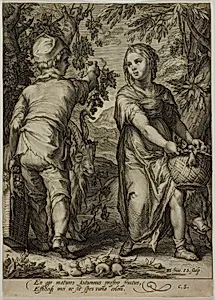
Jan Saenredam’s Four Seasons engravings after his teacher Hendrick Goltzius’s drawings offer lush depictions of flora and fauna through changing times of year. The prints simultaneously follow a young girl and boy’s journey into adulthood. The discovery of the bird’s nest of Spring passes seamlessly into the harvesting of Summer’s ripe crops. Autumn’s root vegetables and fruits attract the interest of a full-grown goat and a pig, while the adults and their loyal hound skate the Winter away on a ...
Art Historical Context
Jan Saenredam *Autumn*, created in1601, belongs to his celebrated *The Four Seasons*. This engraving captures the Dutch artist’s mastery of the medium at the dawn of the seventeenth century, a time when printmaking flourished in the Northern Netherlands. Working in the wake of the Reformation, Saenredam translated seasonal themes into elegant allegories that spoke to both natural cycles and human experience. Engraving on cream laid paper allowed Saenredam to remarkable precision and tonal subtlety through fine, controlled lines. The modest scale—roughly22 by 16 centimeters—made the print ideal for private contemplation or inclusion in’ albums, reflecting the growing popularity of affordable art among the emerging middle class. As part of a set depicting spring, summer, autumn, and winter, the work invites viewers to reflect on time’s passage. Today it resides in the Art Institute of Chicago’s Prints and Drawings collection, offering a vivid window into early modern European attitudes toward nature, order, and the rhythms of daily life.
About the Artist
Jan Saenredam · 1565–1607
Jan Pieterszoon Saenredam (c. 1565–1607) emerged from humble beginnings in the Dutch village of Assendelft, where he was orphaned young and raised by his uncle, the local bailiff Pieter de Jongh. Initially destined for basket weaving or farm work, Saenredam's precocious talent for embellishing texts with intricate designs caught attention, leading to an apprenticeship in cartography. By 1589, at a...