
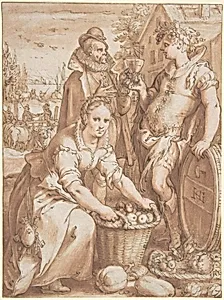
Autumn; Study for an Engraving
Medium
Pen and brown ink, red-brown wash, over black chalk, heightened with a little white gouache
Dimensions
7 5/8 x 5 11/16 in. (19.4 x 14.4 cm)
Classification
Drawings
Department
Drawings and Prints
Museum
Metropolitan Museum of Art, New York, NY
Credit
Rogers Fund, 1961
Accession Number
61.25.2
Rights
Public Domain
Tags
Art Historical Context
Hendrick Goltzi (1558–1617), one of the most celebrated Dutch draftsmen and printmakers of his age, created this lively study as a preparatory drawing for an engraving. Likely part of a series depicting the Four Seasons, “Autumn” captures the abundance and convivial spirit of the harvest through figures enjoying fruit and drink amid a rustic setting. As a leading figure in Northern Mannerism, Goltzius was renowned for his dynamic compositions and technical brilliance, often designing works that would later be translated into widely circulated prints. The drawing’s medium—pen and brown ink with red-brown wash over black chalk, accented with white gouache—reveals Goltzius’s masterful command of light, texture, and volume. These layered techniques allowed him to explore tonal contrasts and sculptural forms essential for the engraving process, where fine lines would ultimately define the final image. Small in scale yet rich in detail, the sheet demonstrates how such studies served as vital bridges between the artist’s imagination and the reproductive print. Thematically, the work reflects early modern Europe’s fascination with seasonal cycles as metaphors for human life and nature’s generosity. Through its intimate portrayal of figures savoring autumn’s bounty, Goltzius invites viewers to appreciate both the sensory pleasures of the season and the artistry behind its representation.
About the Artist
Hendrick Goltzius · 1558–1617
Hendrick Goltzius (1558–1617) was the most celebrated engraver of the Northern Renaissance and a pivotal figure in Dutch Mannerism. Born near the German-Dutch border, Goltzius transformed printmaking into a virtuoso art form through his revolutionary 'swelling line' technique, where the burin was manipulated to create lines of varying thickness that produced unprecedented tonal effects and three-d...