
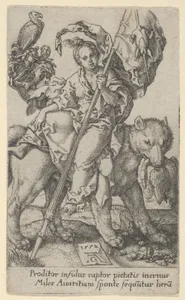
Avarice, from The Vices
Medium
Engraving
Dimensions
Sheet: 4 1/8 × 2 1/2 in. (10.4 × 6.3 cm)
Classification
Prints
Department
Drawings and Prints
Museum
Metropolitan Museum of Art, New York, NY
Credit
Gift of Felix M. Warburg and his family, 1941
Accession Number
41.1.109
Rights
Public Domain
Tags
Art Historical Context
Heinrich Aldegrever, a prominent German engraver of the Northern Renaissance known as one of the "Little Masters" for his exquisite small-scale prints, createdAvarice, from Vices* in 1552. This engraving belongs to a series personifying seven deadly sins, a moralistic theme in 16th-century art amid the Protestant Reformation's emphasis on virtue vice. Aldegrever's precise technique captures the dangers of greed—avarice—through symbolic imagery, likely featuring a woman surrounded by animals evoking hoarding and corruption, such as toads or dragons common in emblematic depictions. Measuring just 4 1/8 × 2 1/2 inches, the work exemplifies engraving's power: ink etched into a copper plate yields intricate details reproducible in multiples, making complex allegories accessible to a wide audience beyond the elite. Aldegrever's style blends Gothic intricacy with emerging Renaissance naturalism, influencing printmaking across Europe. Today, housed in the Metropolitan Museum of Art's Drawings and Prints department (gift of Felix M. Warburg and family, 1941), it reminds visitors of art's role in moral instruction, inviting reflection on timeless human flaws through Aldegrever's masterful lines.
About the Artist
Heinrich Aldegrever · 1502–1561
Heinrich Aldegrever, born in 1502 in Paderborn, Westphalia, to parents Herman and Katherine Trippenmeker—a family of clog-makers known by the dialect name Trippenmecker—emerged as a multifaceted artist in the German Renaissance. His early training remains undocumented, though he likely apprenticed in a Soest goldsmith's workshop after relocating there around 1525, where he joined the painters' gui...