
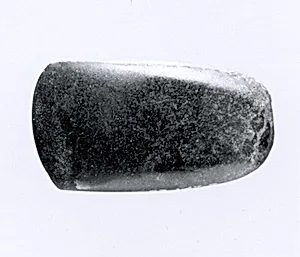
Axe head
Unknown Artist
3rd millennium BCE
Medium
Stone, dark green
Dimensions
1.14 x 2.17 in. (2.9 x 5.51 cm)
Classification
Stone-Implements
Period
Early Bronze Age
Department
Ancient Near Eastern Art
Museum
Metropolitan Museum of Art, New York, NY
Credit
Anonymous Gift, 1963
Accession Number
63.147.6
Rights
Public Domain
Art Historical Context
This petite axe head, crafted from dark green stone, hails from the Early Bronze Age in the Ancient Near East, around the 3rd millennium BCE. Measuring just 1.14 x 2.17 inches, it exemplifies the practical yet skillfully made tools of early urban societies in regions like Mesopotamia and the Levant. During this era, communities were transitioning from nomadic life to settled agriculture and trade, relying on such implements for farming, woodworking, and possibly conflict. The axe's compact form and lustrous dark green material suggest advanced stone-working techniques, likely involving grinding and polishing to achieve a sharp edge and smooth surface. As a stone implement, it predates widespread bronze metallurgy, highlighting the enduring value of durable lithic materials in a time of technological innovation. Its presence in the Metropolitan Museum of Art's Ancient Near Eastern collection—thanks to an anonymous gift in 1963—offers a tangible link to the daily lives and craftsmanship of our ancient ancestors. Though functional, this artifact whispers of cultural ingenuity, reminding us how everyday objects shaped the foundations of civilization.