
Bacchanal
1615–42
Medium
Etching
Dimensions
Sheet: 3 1/4 x 9 15/16 in. (8.2 x 25.2cm)
Classification
Prints
Department
Drawings and Prints
Museum
Metropolitan Museum of Art, New York, NY
Credit
Bequest of Grace M. Pugh, 1985
Accession Number
1986.1180.503
Rights
Public Domain
Tags
Art Historical Context
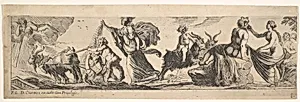
Pierre Brebiette's *Bacchanal*, an etching created between 1615 and1642, captures the wild exuberance of a mythological revelry honoring Bacchus, the Roman god of wine. This intimate sheet, measuring just 3¼ x 9⅞ inches, teems with dynamic figures—bacchantes (frenzied female followers), men, women, and—in a chaotic dance of ecstasy and abandon. The horizontal format draws viewers into the frenzy, evoking the Dionysian spirit central to classical mythology and Renaissance art traditions. As a master of etching, Brebiette employed a meticulous printmaking technique, biting lines into a metal plate with acid to produce rich, tonal effects and fine details. This medium was revolutionary in the early 17th century, allowing artists like Brebiette—a French engraver bridging Mannerism and Baroque—to disseminate intricate compositions affordably. Bacchanal scenes, popularized by predecessors like Titian, symbolized uninhibited joy, fertility, and the blurred line between civilization and primal impulse, resonating in Europe's courts amid growing interest in classical antiquity. Housed in the Metropolitan Museum of Art's Drawings and Prints department through the 1985 bequest of Grace M. Pugh, this work invites modern visitors to revel in its timeless energy. Though small, its vivid etching preserves a snapshot of 17th-century artistic vitality.
About the Artist
Pierre Brebiette · 1598–1642
Pierre Brébiette (c. 1598–c. 1642) was a French painter and etcher whose elegant, sensuous treatment of classical mythology and allegory earned him a significant reputation in early seventeenth-century Paris. Born in Mantes-sur-Seine, Brébiette traveled to Italy as a young man and lived and worked in Rome from around 1617 to approximately 1625, absorbing the influences of ancient sculpture, Renais...