
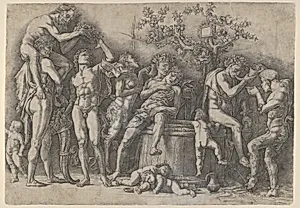
Bacchanal with Wine Vat
before 1475
Medium
Engraving
Dimensions
Sheet: 11 13/16 × 16 3/4 in. (30 × 42.5 cm)
Classification
Prints
Department
Drawings and Prints
Museum
Metropolitan Museum of Art, New York, NY
Credit
Anonymous Gift, 1929
Accession Number
29.44.16
Rights
Public Domain
Tags
Art Historical Context
Andrea Mantegna's *Bacchanal with Wine*, an engraving created before 1475, captures the wild exuberance of classical revelry in intricate detail. As a leading figure of the Early Italian Renaissance, Mantegna was renowned for his of perspective and classical motifs, bridging antiquity with his contemporary world in Padua and Mant. This print, measuring 11 13/16 × 16 3/4 inches, exemplifies his innovative foray into printmaking, a medium that allowed artists to reach wider audiences beyond elite patrons. The scene bursts with mythological energy: satyrs, men, and even children cavort around a massive wine vat, embodying Dionysian themes of drunkenness and uninhibited joy. Mantegna's engraving technique—incising fine lines into a copper plate for inking and printing—produces crisp, textured effects that convey motion and texture, from flowing drapery to the chaos of the feast. Such prints were revolutionary, influencing later artists like Dürer and preserving Mantegna's vision in multiples. Housed in the Metropolitan Museum of Art's Drawings and Prints department (Anonymous Gift, 1929), this work reflects Renaissance fascination with Greco-Roman bacchanals, celebrating excess while nodding to humanist ideals. It's a lively window into 15th-century interpretations of ancient ecstasy.
About the Artist
Andrea Mantegna · 1431–1506
Andrea Mantegna was born around 1431 near Padua, in the Venetian Republic, the son of a carpenter. At approximately age eleven he was taken into the workshop of the Paduan painter and antiquities collector Francesco Squarcione, who enrolled him as a guild member and immersed him in the study of Roman sculpture and classical Latin. Though Mantegna later claimed that Squarcione had exploited his lab...