Ctrl K
1431–1506
Andrea Mantegna was born around 1431 near Padua, in the Venetian Republic, the son of a carpenter. At approximately age eleven he was taken into the workshop of the Paduan painter and antiquities collector Francesco Squarcione, who enrolled him as a guild member and immersed him in the study of Roman sculpture and classical Latin. Though Mantegna later claimed that Squarcione had exploited his labor, the apprenticeship proved formative, instilling a passion for classical antiquity that would define his art throughout his life. At seventeen he broke legally from Squarcione and was soon receiving commissions in his own right, including work in the Ovetari Chapel at the church of the Eremitani in Padua — frescoes that established his early reputation.
In 1453, Mantegna married Nicolosia Bellini, daughter of the painter Jacopo Bellini, making him brother-in-law to Giovanni and Gentile Bellini and situating him at the center of Venetian artistic life. His San Zeno Altarpiece (1457–1460) and the Agony in the Garden (c. 1459) reveal the qualities that set him apart: a sculptor's feel for form, archaeological precision in rendering classical armor and architecture, and a mastery of dramatic perspective. In 1460, the Marquis Ludovico III Gonzaga appointed him court artist in Mantua, a post he held for the remainder of his life. There he produced his greatest achievement, the Camera degli Sposi (1465–1474) in the Palazzo Ducale, in which illusionistic frescoes dissolve the walls and ceiling into an imagined open space — a feat of trompe-l'oeil that astonished contemporaries and influenced ceiling painting for two centuries.
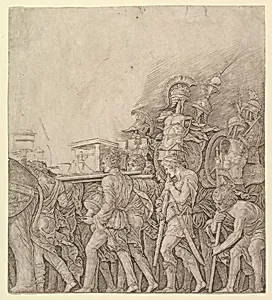
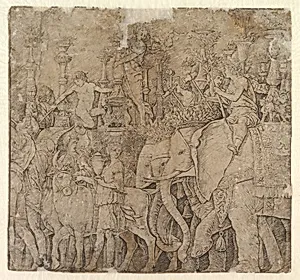
Among his later masterworks are the Triumphs of Caesar (c. 1486), a monumental series of nine canvases depicting a Roman triumphal procession, and the Lamentation over the Dead Christ (c. 1490), in which the foreshortened body of Christ is rendered from a startlingly low viewpoint — one of the most audacious exercises in perspective in all of Renaissance painting. Mantegna died in Mantua on September 13, 1506. His rigorous classicism and spatial inventiveness provided a foundational framework for generations of northern Italian painters and left an indelible mark on the Renaissance tradition.