
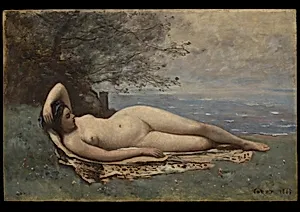
Bacchante by the Sea
1865
Medium
Oil on wood
Dimensions
15 1/4 x 23 3/8 in. (38.7 x 59.4 cm)
Classification
Paintings
Department
European Paintings
Museum
Metropolitan Museum of Art, New York, NY
Credit
H. O. Havemeyer Collection, Bequest of Mrs. H. O. Havemeyer, 1929
Accession Number
29.100.19
Rights
Public Domain
Tags
Art Historical Context
Camille Corot's *Bacchante by the Sea* (1865) captures a mythical reveler—a bacchante, one of the ecstatic followers of Bacchus, the god of wine—in a serene seaside landscape. Painted in oil on wood, this intimate panel (15¼ × 23⅜ in.) showcases Corot's masterful blend of realism and lyricism. The compact wooden support allowed for precise, luminous brushwork, evoking the soft glow of sunlight on water and flesh, a technique honed during his Barbizon School years in the forests of Fontainebleau. As a leading figure painter and landscapist, Corot bridged Romanticism and Impressionism. By the 1860s, his late style infused classical themes with dreamy naturalism, making the bacchante's nude form appear both timeless and tenderly human against the vast sea. This work reflects 19th-century French fascination with antiquity, revived through neoclassical ideals amid the Second Empire's cultural flourish. A gem from the H.O. Havemeyer Collection, bequeathed to The Metropolitan Museum of Art in 1929, *Bacchante by the Sea* invites visitors to ponder the harmony of myth, body, and nature—Corot's enduring gift of poetic tranquility.
About the Artist
Camille Corot · 1796–1875
Jean-Baptiste-Camille Corot, born in Paris on July 16, 1796, into a prosperous bourgeois family—his father a former wig maker turned draper, his mother a successful milliner—initially resisted his artistic calling. After a lackluster education at the Lycée Pierre-Corneille in Rouen and failed apprenticeships in business, he abandoned commerce at age 26, thanks to a generous parental allowance foll...