
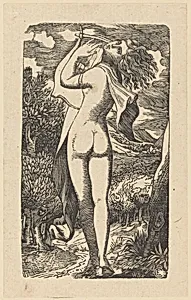
Bacchante
Medium
wood engraving on wove paper
Dimensions
image: 9 x 5.3 cm (3 9/16 x 2 1/16 in.) sheet: 10.5 x 6.6 cm (4 1/8 x 2 5/8 in.) support: 42 x 31.8 cm (16 9/16 x 12 1/2 in.)
Classification
Department
CG-E
Museum
National Gallery of Art, Washington, D.C.
Credit
Gift of Charles Ryskamp in honor of Paul Mellon, and in Honor of the 50th Anniversary of the National Gallery of Art
Accession Number
1991.154.10
Rights
Public Domain
Art Historical Context
Created around 1830, this delicate wood engraving titled *Bacchante* captures a moment of classical inspiration through the collaborative efforts of Welby Sherman and Edward Calvert. As a print after Calvert’s design, it reflects the early nineteenth-century fascination with mythological subjects, particularly the followers of Bacchus known for their ecstatic revelry. The small scale—measuring just over three inches in height—suggests it may have been intended for private viewing or inclusion in a portfolio rather than large public display. Wood engraving, the medium employed here, involves carving fine lines into the end grain of hardwood blocks, allowing for intricate detail and crisp reproduction. Popular during the period for both artistic and commercial printmaking, the technique enabled artists like Sherman to translate Calvert’s visionary imagery into accessible multiples. This example, printed on wove paper, highlights the precision and tonal subtlety possible with the process. Donated to the National Gallery of Art by Charles Ryskamp in honor of Paul Mellon and the museum’s fiftieth anniversary, the work stands as a testament to the enduring appeal of Romantic-era interpretations of antiquity. Its intimate size invites close contemplation, rewarding viewers with the quiet power of line and form.