
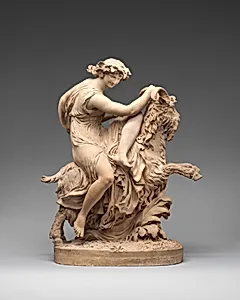
Bacchante Riding a Goat
Medium
Pale buff terracotta
Dimensions
Height: 15 3/4 in. (40 cm)
Classification
Sculpture
Culture
French, Paris
Department
European Sculpture and Decorative Arts
Museum
Metropolitan Museum of Art, New York, NY
Credit
Purchase, Charles Ulrick and Josephine Bay Foundation Inc. Gift, 1975
Accession Number
1975.312.8
Rights
Public Domain
Tags
Art Historical Context
In the European Sculpture and Decorative Arts collection at the Metropolitan Museum of Art, Philippe Roland's *Bacchante Riding a* (1796) captures the exuberant spirit of classical mythology. Crafted in Paris during the late 18th century this 15¾-inch (40 cm) pale buff terracotta sculpture depicts achante—a fervent female follower of Bacchus the Roman god of wine—astride a lively goat. The dynamic pose evokes the wild revelry and ecstasy associated with Dionysian rites, blending whimsy with ancient tradition. Terracotta, a fired clay medium valued for its earthy warmth and malleability, allowed Roland to skillfully model fluid drapery, expressive features, and the goat's spirited motion. Often used for sculptors' preparatory studies or bozzetti, this intimate scale invites close contemplation, highlighting textures from the Bacchante's flowing hair to the animal's coiled form. The pale buff tone enhances its classical restraint while radiating vitality. This French work reflects the era's enduring passion for Greco-Roman themes, bridging antiquity and Enlightenment ideals. A generous gift to the Met in 1975, it reminds visitors of sculpture's power to bring mythological abandon to life in enduring clay.