
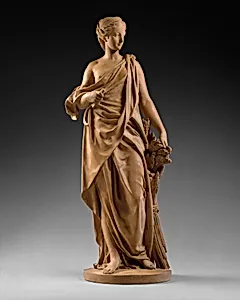
Ceres
ca. 1768–70
Medium
Buff terracotta with reddish patination
Dimensions
Overall: 24 5/8 × 7 1/2 × 7 1/2 in. (62.5 × 19.1 × 19.1 cm)
Classification
Sculpture
Culture
French, Paris
Department
European Sculpture and Decorative Arts
Museum
Metropolitan Museum of Art, New York, NY
Credit
Purchase, C. Michael Paul Gift, Josephine Bay Paul and C. Michael Paul Foundation Inc. Gift, and Charles Ulrick and Josephine Bay Foundation Inc. Gift, 1978
Accession Number
1978.2
Rights
Public Domain
Tags
Art Historical Context
Augustin Pajou's *Ceres*, crafted around 1768–70, the Roman goddess of agriculture in a graceful terracotta sculpture that exemplifies French neoclassical artistry from Paris. Standing nearly two feet tall, this buff terracotta figure with its subtle reddish patination likely served as a modello—a preparatory model—for larger marble works, a common practice among 18th-century sculptors Pajou, a leading court artist under Louis XV and XVI, blended Rococo elegance with emerging neoclassical restraint, infusing mythological subjects like Ceres with poised vitality and classical harmony. The medium of terracotta was prized for its warmth and malleability, allowing artists to refine forms through modeling before committing to stone. Pajou's sensitive handling of surface texture and patination evokes the earth's fertility Ceres embodies, her form radiating both strength and serenity amid France's Enlightenment-era fascination with antiquity. Acquired by The Metropolitan Museum of Art in 1978 through generous gifts, this piece offers visitors a window into the ateliers of pre-Revolutionary Paris, where sculpture bridged decorative luxury and intellectual revival. (178 words)
About the Artist
Augustin Pajou · 1730–1809
Augustin Pajou (1730–1809) was one of the foremost French sculptors of the second half of the eighteenth century, whose long and distinguished career bridged the Rococo grace of the Ancien Régime and the more sober classicizing spirit that emerged in the revolutionary and Napoleonic periods. Born in Paris into a family with artistic connections — his father was an ornamental sculptor — Pajou showe...